
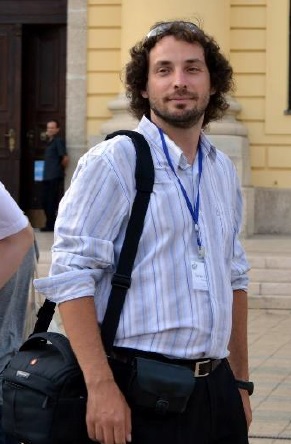
István Elek Maák
Education:
2010 – 2015 Ph.D. in Environmental Sciences, Faculty of Natural Sciences and Informatics, Department of Ecology, University of Szeged, Hungary. Title of Ph.D. thesis “Food sources, signals or infection focuses – the role of corpses in different ant species”
Research interests:
I am interested in individual behavioural differences (personality) in animal species. My main research focuses on ants, particularly on how individual differences influence division of labour and contribute to colony success, especially in the context of tool use. I am also interested in the relationships among individual behavioural traits, cognitive abilities, and molecular immunity.
In addition, my research addresses ecological aspects, such as how the functional and behavioural trait organisation of ant communities varies with microclimate, habitat type, and global climate change. I also study keystone species such as red wood ants, examining their colony organisation and the crucial roles they play in forest ecosystems.
Implemented grants and projects
As PI:
1. 2022 – 2025: Bolyai János Research Grant of the Hungarian Academy of Sciences
2. July 2023: STAR-UBB Academic Research Network of Excellence (STAR-UBB-N) Grant of the Babeş-Bolyai University
3. 2022 – 2024: Bolyai+ Higher Education Grant for Young Teachers and Researchers
4. 2018: Mobility grant for young scientists of the Romanian Ministry of Research and Innovation
5. 2017 – 2018: “Miniatura” research grant of the Polish National Science Centre: Ants hygienic defence-mechanism against pathogens with different virulence
6. 2017 – 2018: Excellence Grant of the Polish Academy of Sciences for young researchers: Study of colony structure and organisation of red wood ants in Central Europe
As Collaborator:
1. 2022 – 2026: OTKA grant of the National Research, Development and Innovation Office, University of Szeged, Hungary: A természetes és antropogén zavarások hatása a jelenlegi és a potenciális jövőbeli mikrorefúgiumok élővilágára (The effects of natural and anthropogenic disturbances on the biodiversity of current and potential future microrefugia).
2. 2016 – 2025: Joint research program between the Polish Academy of Sciences and the Romanian Academy.
3. 2019 – 2023. OPUS grant of the Polish National Science Centre: Adaptations and ongoing coevolution in source and reintroduced populations of the obligatorily myrmecophilous butterfly Maculinea teleius.
4. 2021–2022: Joint research program between the Narodowa Agencja Wymiany Akademickiej (NAWA) and the German Academic Exchange Service (DAAD): The effect of urbanization on ant phenology.
5. 2018 – 2019: Joint research collaboration with Laboratoire d'Ethologie Expérimentale et Comparée, University Paris 13.
6. 2017 – 2021: Grant K_17 of the National Research, Development and Innovation Office, University of Szeged, Hungary.
7. 2016 –2019: “OPUS” research grant of the Polish National Science Centre: Personality in ants and factors influencing its development.
8. 2011 – 2012: Hungary-Romania Cross-Border Cooperation Programme 2007-2013 HURO 0901/205 and HURO 0801, University of Szeged, Faculty of Natural Science and Informatics, Department of Ecology, Szeged, Hungary.
Staff training/Popularization/Awards and distinctions
• Supervisor of PhD student with obtained degree in 2022.
• Ongoing supervision of four PhD students
• Supervision of more than 40 student internships (32 bachelors, 12 masters)
• Vice-president of the Central European Section of the IUSSI.
• President of the Hungarian Ethological Society.
• Member of the Scientific Association of Hungarian Ecologist (Magyar Ökológusok Tudományos Egyesülete: MÖTE).
• Member of the public body, Diversity Biology Committee of the Hungarian Academy of Sciences.
• 27-30 August 2025: Head of the organising committee of the Central European section meeting of the International Union for the Study of Social Insects (Szeged, Hungary).
• 15-18 September 2011, 24-27 July 2015, 8-11 September 2024: Central European Workshop of Myrmecology (Cluj-Napoca, Romania; Debrecen, Hungary; Sibiu, Romania).
• 14-18 March 2013; 17-20 September 2023: Central European section meeting of the International Union for the Study of Social Insects (both in Cluj-Napoca, Romania).
• 2-5 April 2013: National Scientific Students Conference, University of Szeged, Department of Ecology, Hungary.
• 25 September 2015, 30 September 2022, 29 September 2023: Main organizer of the “Researcher’s night”, University of Szeged, Department of Ecology, Hungary.
Selected publications
1. Martin R., Leroy C., Maák I./d’Ettorre P. (2024): Group phenotypic composition drives task performances in ants. Biology Letters 20: 20230463. DOI: 10.1098/rsbl.2023.0463
2. Lőrincz A., Hábenczyus A. A., Kelemen A., Ratkai B., Tölgyesi Cs., Lőrinczi G., Frei K., Bátori Z., Maák I. E. (2024): Wood-pastures promote environmental and ecological heterogeneity on a small spatial scale. Science of The Total Environment 906: 167510. DOI: 10.1016/j.scitotenv.2023.167510
3. Trigos-Peral G., Juhász O., Kiss P. J., Módra G., Tenyér A., Maák I. (2021): Wood ants as biological control of the forest pest beetles Ips spp. Scientific Reports 11: 11931. DOI: 10.1038/s41598-021-96990-5
4. Maák I., Trigos-Peral G., Ślipiński P., Grześ I. M., Horváth G., Witek M. (2021): Habitat features and colony characteristics influencing ant personality and its fitness consequences. Behavioral Ecology 32: 124–137. DOI: 10.1093/beheco/araa112
5. Maák I., Roelandt G., d'Ettorre P. (2020): A small number of workers with specific personality traits perform tool use in ants. eLife 9: e61298. DOI: 10.7554/eLife.61298
6. Maák I., Tóth E., Lenda M., Lőrinczi G., Kiss A., Juhász O., Czechowski W., Torma A. (2020): Behaviours indicating cannibalistic necrophagy in ants are modulated by the perception of pathogen infection level. Scientific Reports 10: 17906. DOI: 10.1038/s41598-020-74870-8. Myrmecological News Blog: Cannibalistic necrophagy in the wood ant Formica polyctena, https://blog.myrmecologicalnews.org/2020/12/29/cannibalistic-necrophagy-in-the-wood-ant-formica-polyctena/
7. Maák I., Camera J., Casacci L. P., Barbero F., Trigos-Peral G., Slipiński P., Bonelli S., Zaccagno M., Witek M. (2019): The influence of colony traits on the collective behaviour of Myrmica scabrinodis ants. Insect Conservation and Diversity 12: 481–491. DOI: 10.1111/icad.12352
8. Lőrinczi G., Módra G., Juhász O., Maák I. E. (2018): Which tools to use? Choice optimization in the tool-using ant, Aphaenogaster subterranea. Behavioral Ecology 29: 1444–1452. DOI: 10.1093/beheco/ary110. Review blog: https://blog.oup.com/2018/10/ants-pick-tools-foraging-beheco/
9. Maák I., Lőrinczi, G., Le Quinquis, P., Modra, G., Bovet, D., Call, J., d'Ettorre, P (2017): Tool selection during foraging in two species of funnel ants. Animal Behaviour 123: 207–216. DOI: 10.1016/j.anbehav.2016.11.005. New Scientist review: https://www.newscientist.com/article/2116641-ants-craft-tiny-sponges-to-dip-into-honey-and-carry-it-home/
10. Maák I., Markó B., Erős K., Babik H., Ślipiński P., Czechowski W. (2014): Cues or meaningless objects? Differential responses of the ant Formica cinerea to corpses of competitors and enslavers. Animal Behavior 91: 53–59. DOI: 10.1016/j.anbehav.2014.02.014